Red light therapy has moved well beyond the walls of dermatology offices. Today, it shows up in luxury spas, sports recovery centers, and on the bathroom counters of skin-savvy professionals who treat their wellness routine with the same rigor they apply to everything else. But as the technology has become more accessible, a real question has emerged: does it actually matter where you get your treatment?
The short answer is: it depends on your goal. In-clinic systems generally deliver higher irradiance across a larger coverage area, which makes them well-suited for intensive or full-body applications. At-home devices offer something equally valuable: consistency. For targeted skin concerns, a high-quality device used regularly can produce meaningful, visible results. Neither option is objectively superior. The right choice comes down to what you're treating, how often you can commit, and what trade-offs you're willing to make.
Here's what the science and real-world experience actually support.
What Red Light Therapy Actually Does to Your Skin
Red light therapy, also known as photobiomodulation, works by delivering targeted wavelengths of light, typically in the 630–660 nm range, to the skin. Those wavelengths are absorbed by mitochondria, the energy-producing structures within skin cells, which respond by increasing cellular activity. For the skin specifically, this means encouraging the collagen-producing cells in the deeper layers of the dermis to rebuild the structural protein responsible for firmness and resilience.
Research has confirmed that red light therapy is a noninvasive approach for improving skin structure and stimulating collagen renewal.² A landmark controlled trial published in Photomedicine and Laser Surgery enrolled 136 volunteers and measured results across 30 sessions, reporting measurable increases in intradermal collagen density over a 15-week period.¹ These are genuine structural changes, reflecting real renewal that takes place within the skin over time.
Crucially, red light therapy is a non-thermal technology: it uses no UV radiation and does not cause heat-related damage to skin tissue. It is safe for all skin tones and requires no recovery time.
Power Output and Irradiance: The Core Difference
The most meaningful difference between in-clinic and at-home red light therapy is not the type of light used. Both settings work with the same red and near-infrared wavelengths that photobiomodulation research is built on. What differs is irradiance: the amount of light energy delivered per square centimeter of skin.
Professional systems operate at significantly higher irradiance levels and cover a much larger surface area, often the entire body at once. This allows for shorter, more intense sessions that can reach deeper tissue layers in a single visit.
That said, irradiance is only one side of the equation. The total dose delivered, measured in joules per square centimeter, is what ultimately drives results. And dose is a function of both irradiance and time. A well-engineered at-home device used consistently for regular sessions can, over time, deliver a meaningful cumulative dose.
At-Home vs. In-Clinic: What Each Option Does Best
Skin Rejuvenation and Anti-Aging
For targeted facial anti-aging, at-home LED devices have a strong, peer-reviewed track record.¹ The key variable is consistency. A device used five times a week will outperform a higher-powered clinic session attended twice a month, for this particular goal.
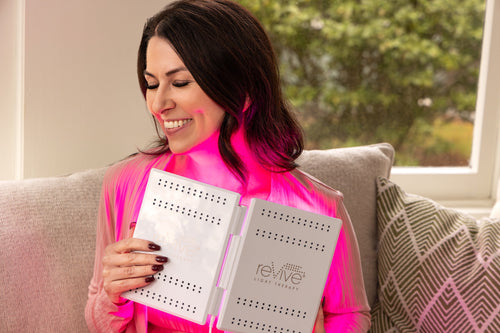
reVive Light Therapy™, built on nearly 20 years of R&D by LED Technologies, Inc., offers a range of FDA-cleared devices specifically engineered for this purpose. The Lux Clinical delivers red and blue light in a professional-inspired panel format designed for home use. In an in-house study conducted by LED Technologies, Inc., 97.4% of participants observed a visible improvement in the appearance of wrinkles, fine lines, or skin tone after consistent use with red light.
Hair Regrowth
Hair regrowth is one area where clinical systems tend to hold a clear advantage. Higher irradiance combined with full scalp coverage and controlled session parameters makes in-clinic treatments more effective for this application. Most at-home devices are designed for facial or localized use, which limits their practical reach for scalp treatments.
Muscle Recovery and Deep-Tissue Applications
For deeper tissue work, including joint discomfort or muscle recovery, the clinical environment again has the advantage. Professional systems capable of delivering near-infrared light at high irradiance levels are better positioned for these applications. If this is your primary concern, professional sessions are worth considering, particularly when supervised by a trained provider.
At-Home vs. In-Clinic: A Side-by-Side Comparison
|
Factor |
In-Clinic |
At-Home |
|
Irradiance |
High (professional-grade) |
Moderate (varies by device) |
|
Coverage area |
Full-body possible |
Targeted / facial panels |
|
Session cost |
$75–$250 per visit |
One-time device investment |
|
Frequency |
Limited by appointments |
Daily access |
|
Best for |
Deep tissue, hair regrowth, full-body |
Facial anti-aging, acne, daily maintenance |
|
Supervision |
Trained professional |
Self-directed |
The Cost Equation
A single professional red light therapy session typically runs between $75 and $250. For meaningful skin results, a course of 10 to 20 sessions is often recommended, putting the upfront investment at $750 to $5,000 or more, with ongoing maintenance sessions adding to that figure over time.
A quality at-home device represents a one-time investment that pays for itself quickly for anyone committed to regular use. The reVive Light Therapy™ Lux Collection ranges from $39 for targeted spot treatments to $399 for the professional-grade Lux dpl® IIa panel, which delivers clinical-level LED coverage for home use. Orders over $75 ship free within the contiguous US, and many of these devices qualify for FSA/HSA reimbursement, which is worth factoring into any long-term wellness budget.
Frequency and Consistency: The At-Home Advantage
This is where at-home therapy genuinely shines. The photobiomodulation literature is consistent on one point: regular, repeated exposure drives results.² When a clinic session requires scheduling, commuting, and a session fee every single time, most people end up going far less frequently than the science recommends. An at-home device sitting on your bathroom counter removes every friction point. That accessibility is a real advantage, not just a convenience argument.
Is At-Home Red Light Therapy Worth It?
For anyone looking to address visible signs of aging, improve skin texture, or manage acne consistently over time, a well-chosen at-home device is a sound investment. The photobiomodulation mechanism that produces results at the cellular level is the same whether the treatment takes place at home or in a professional setting.² The science behind LED light therapy is well-established, with decades of peer-reviewed research supporting its use for skin health applications.
Where clinical treatment provides clear added value is in full-body applications, medically supervised protocols, or situations where maximum irradiance and professional oversight are genuinely needed.
For day-to-day skin wellness, an at-home device from a credible, FDA-cleared brand is both effective and practical.
Safety and What to Keep in Mind
Red light therapy has a strong safety profile. It is a non-thermal technology, generates no UV radiation, and does not cause damage to skin tissue at the intensities used in both home and clinical settings. Eye protection is generally recommended during sessions, particularly with panel-style devices.
Not all devices are created equal. Look for FDA clearance, published wavelength specifications, and clearly stated irradiance values at a defined treatment distance. Wattage figures alone are not a reliable indicator of performance: irradiance, measured in milliwatts per square centimeter (mW/cm²), is the metric that actually tells you how much light energy your skin is receiving at the treatment surface.
As with any wellness practice, consistency matters more than intensity. A thoughtful, regular routine will always outperform occasional high-powered sessions.
Who Should Choose Which Option?
Choose in-clinic treatments if:
● You are targeting hair regrowth or a specific medical concern
● You need full-body coverage for muscle recovery or joint health
● You prefer supervised sessions with a trained provider
● You want the fastest possible results in the shortest time
Choose at-home therapy if:
● Your primary goal is facial anti-aging, skin texture, or acne management
● You want the flexibility of daily sessions on your own schedule
● You are looking for a long-term, performance-driven solution
● You prefer integrating light therapy into your existing skincare routine
For most people with skin-focused goals, a high-quality at-home device used consistently is the most practical and effective path forward.
Explore the full reVive Light Therapy™ Anti-Aging Collection or discover the Lux Collection to find the device that fits your goals.
Frequently Asked Questions
Is red light therapy better at home or in a professional setting?
Neither option is universally superior. In-clinic systems deliver higher irradiance and are better suited for full-body treatments, hair regrowth, or deep-tissue applications. At-home devices excel for facial anti-aging and daily maintenance because they allow consistent, frequent use. For most skin-focused goals, a quality at-home device used regularly produces strong results.
Is at-home red light therapy actually worth the investment?
For anyone committed to a consistent routine, yes. The photobiomodulation mechanism that drives results, such as collagen stimulation and cellular restoration, is the same at home as in a clinic. The key difference is frequency: daily access to an at-home device typically leads to more cumulative treatment time than occasional clinic visits, which is a meaningful advantage for long-term skin health.
What should I look for in an at-home red light therapy device?
Prioritize FDA clearance, published irradiance values at a stated treatment distance (in mW/cm²), and the appropriate wavelengths for your goal, typically 630–660 nm for skin rejuvenation and anti-aging. Coverage area matters too: a facial panel is well-matched to skin concerns, while full-body goals may require a larger device or in-clinic support.
Is red light therapy scientifically supported, or is it overhyped?
The science behind red light therapy is well-established in the photobiomodulation literature. Peer-reviewed, controlled trials have demonstrated measurable improvements in skin collagen density, wrinkle reduction, and skin texture following consistent LED treatment at the appropriate wavelengths and doses.¹ It is one of the more rigorously studied noninvasive approaches to skin wellness available today.
Scientific References
¹ Wunsch A, Matuschka K. "A Controlled Trial to Determine the Efficacy of Red and Near-Infrared Light Treatment in Patient Satisfaction, Reduction of Fine Lines, Wrinkles, Skin Roughness, and Intradermal Collagen Density Increase." Photomedicine and Laser Surgery, 32(2), 2014. https://pubmed.ncbi.nlm.nih.gov/24286286/
² Avci P, et al. "Low-level laser (light) therapy (LLLT) in skin: stimulating, healing, restoring." Seminars in Cutaneous Medicine and Surgery, 32(1), 2013. https://pubmed.ncbi.nlm.nih.gov/24049929/