

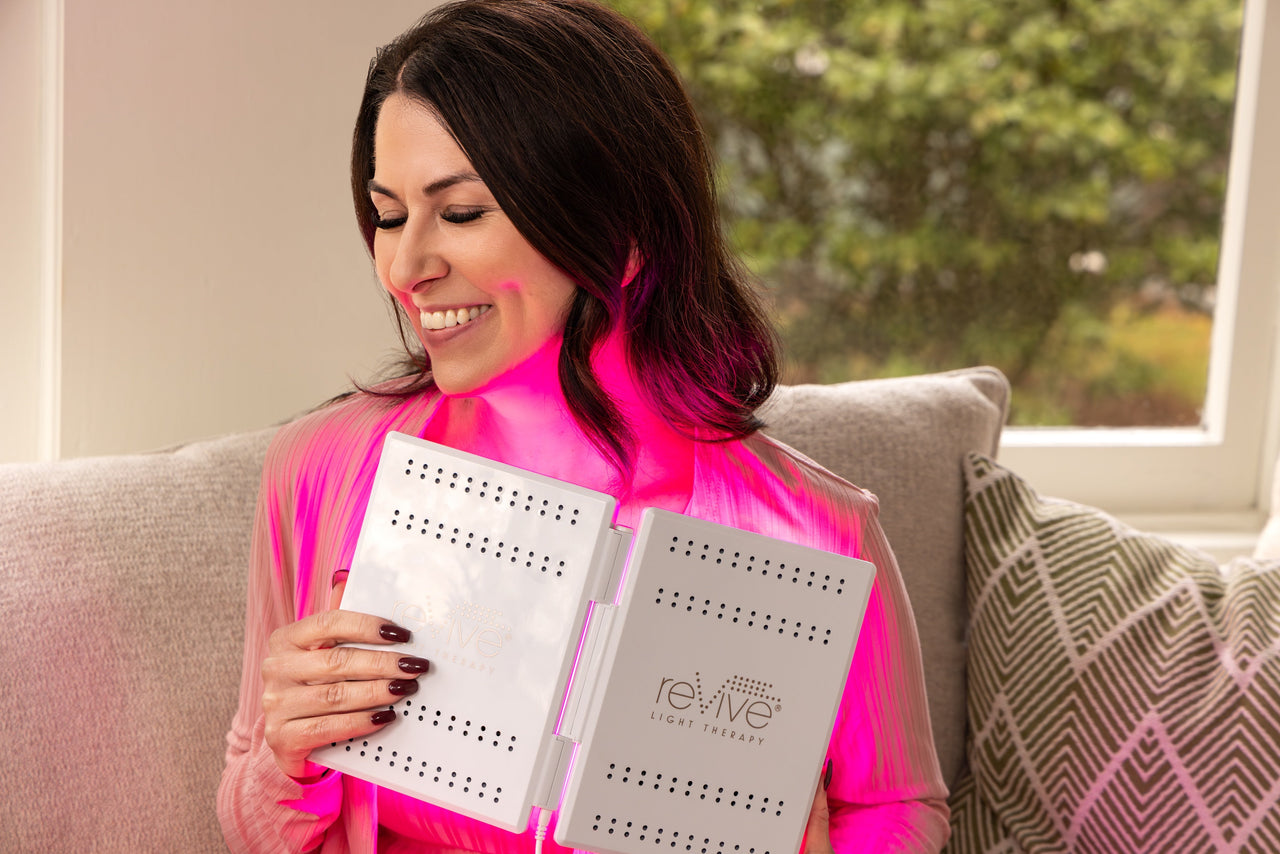
If you've been exploring at-home LED therapy, you've almost certainly landed on this question: should you invest in a red light panel or an LED face mask? Both have earned real credibility in the wellness space, both are backed by solid science, and both can produce visible results. But they are not interchangeable, and choosing the wrong format for your goals is the most common mistake people make.
This guide breaks it all down clearly, so you can make a decision grounded in how these devices actually work, not just marketing copy.
How Red Light Therapy Works in Both Devices
Before comparing formats, it helps to understand what they share. Both red light panels and LED masks operate on the same biological principle: photobiomodulation. This is the process by which specific wavelengths of light are absorbed by cells, triggering natural responses like increased cellular energy production and collagen synthesis.
Research published in Photomedicine and Laser Surgery confirmed that non-thermal photobiomodulation using red and near-infrared light is both safe and effective for improving skin appearance and collagen density.¹
The wavelengths most commonly used in both panels and masks fall within two ranges: red light at 630–660 nm, which targets the skin's surface and upper dermal layers, and near-infrared (NIR) light at 810–850 nm, which penetrates deeper into tissue. Red light is well suited for skin surface benefits like collagen support and tone improvement, while near-infrared light reaches deeper layers, making it more relevant for muscle recovery and joint wellness.
The key takeaway here: it is not the device format that determines the quality of the light. It is the wavelengths used, the irradiance (power output), and how consistently you use it.
Red Light Masks: Precision for Your Face
An LED face mask is worn directly against the skin and covers the face and, in some cases, the neck. Because the light source sits in close contact with the skin, masks can deliver effective doses of light even at lower power levels.
Key Benefits of LED Masks
● Hands-free convenience. You can wear a mask while doing other things, which makes consistent daily use realistic.
● Targeted facial coverage. Every LED sits within inches of your skin, maximizing light contact across the face.
● Portable and compact. A mask fits in a bag, making it easy to maintain your routine while traveling.
● An approachable investment. Quality masks typically range from $100 to $400, making them a natural entry point into LED therapy.
● Clinically meaningful outcomes. A randomized controlled trial evaluating red LED protocols specifically for facial rejuvenation found that in vitro red photobiomodulation improved collagen synthesis, with measurable reductions in periocular wrinkle volume.²
In an in-house study conducted by LED Technologies, Inc., 97.4% of participants reported a visible improvement in fine lines, wrinkles, or skin tone after consistent use of a red light device.
Limitations of LED Masks
● Coverage is limited to the face and neck. For skin concerns on the chest, back, or scalp, a mask will not reach those areas.
● Irradiance is typically lower, ranging from approximately 5 to 30 mW/cm², though proximity to the skin compensates for this in facial applications.
● Most masks are designed for surface-level skin benefits and are not the right tool for deep tissue recovery.
Red Light Panels: Power and Versatility for the Whole Body
A red light panel is a freestanding or wall-mounted device that emits high-intensity light across a large surface area. You position yourself at a measured distance from it, typically 6 to 18 inches, and treat the target area for a set amount of time.
Key Benefits of Red Light Panels
● High irradiance. Panels typically output 100 mW/cm² or more, delivering a therapeutic dose faster than most masks.
● Full-body or multi-zone coverage. A single session can address the face, neck, chest, back, arms, or scalp depending on positioning.
● Greater tissue depth. Red light at 630–660 nm supports skin health and collagen production in the upper skin layers, while near-infrared light at 810–850 nm reaches deeper into muscle and connective tissue. Panels frequently offer both wavelength ranges within a single device.
● Faster sessions. Higher irradiance means the same therapeutic energy dose can be delivered in less time.
Limitations of Red Light Panels
● Requires active positioning. Unlike a mask that sits directly on your face, a panel requires you to stand or sit in place at the correct distance for the full session duration.
● Higher investment. Quality panels range from roughly $200 to $1,500 or more depending on size and specifications.
● Setup and learning curve. Getting the right distance and session timing matters more with panels than with masks, where proximity to the skin is built-in.
Head-to-Head Comparison
|
Feature |
LED Mask |
Red Light Panel |
|
Coverage area |
Face and neck |
Full body, customizable |
|
Irradiance |
5–30 mW/cm² |
100+ mW/cm² |
|
Skin depth (red light) |
Epidermis and upper dermis |
Dermis and deeper tissue |
|
Session length |
10–20 minutes |
10–30 minutes (distance-dependent) |
|
Portability |
High |
Low |
|
Price range |
$100–$400 |
$200–$1,500+ |
|
Best for |
Facial anti-aging, acne, daily convenience |
Full-body wellness, recovery, versatility |
Which One Should You Choose?
Choose a mask if…
You are focused specifically on facial skin, whether your goal is reducing fine lines, addressing hyperpigmentation, or managing acne. Masks are also the right choice if you travel frequently, have limited space at home, or want to build a simple daily skincare ritual without disrupting your routine. The reVive Light Therapy™ Lux Clinical ($199) and the Lux Glō ($79) are designed precisely for this: targeted, effective, and effortless to integrate into daily life. Both devices are safe for all skin tones.
Choose a panel if…
Your goals extend beyond facial skin. If you want to support muscle recovery after workouts, address skin concerns across a broader area like the chest or back, or invest in the most powerful at-home device available, a panel is the right choice. The reVive Light Therapy™ Lux dpl IIa ($399) is the brand's premium LED treatment panel, offering professional-level output with blue and red light for both anti-aging and acne applications.
Can you use both?
Absolutely. Many people find that a mask handles daily facial maintenance while a panel addresses larger treatment areas or deeper recovery needs. They operate on the same science and complement each other naturally. If you're building a complete at-home wellness routine, using both strategically by session type and goal is a perfectly sound approach.
Frequently Asked Questions
Is a panel or mask better for red light therapy?
Neither is universally better. A mask delivers targeted, convenient facial treatment at a lower price point, while a panel offers higher power output and broader body coverage. The most effective device is the one you use consistently and that matches your specific goals. Both formats are grounded in the same photobiomodulation science.
Is red light or near-infrared light better for skin?
It depends on your concern. Red light in the 630–660 nm range is the most studied wavelength for skin surface benefits, including collagen support and skin tone improvement. Near-infrared light penetrates more deeply and is generally better suited for muscle recovery and joint wellness rather than surface skin concerns.
What is the most effective red light therapy device?
Effectiveness is defined by your goal. A quality mask used consistently will serve someone focused on facial skin far better than a panel used occasionally. For full-body or deeper recovery applications, a high-irradiance panel with near-infrared capability is the stronger investment. Consistency of use matters more than the format itself.
Can I use an LED face mask if I have glaucoma?
If you have glaucoma or any other eye condition, please consult your ophthalmologist before using any LED light therapy device. While red light therapy does not emit UV radiation, eye safety is a personal medical matter that requires professional guidance. Always follow the safety instructions included with your specific device.
Backed by nearly 20 years of R&D by LED Technologies, Inc. and recognized by Vogue, Allure, and Good Housekeeping, reVive Light Therapy™ offers a complete range of clinically informed devices, from thoughtfully designed everyday tools to professional-grade panels, so you can find exactly what your skin routine calls for.
Explore the full Lux Collection
¹ Wunsch A, Matuschka K. "A controlled trial to determine the efficacy of red and near-infrared light treatment in patient satisfaction, reduction of fine lines, wrinkles, skin roughness, and intradermal collagen density increase." Photomedicine and Laser Surgery, 32(2), 2014. https://pubmed.ncbi.nlm.nih.gov/24286286/
² Mota LR, et al. "Photobiomodulation reduces periocular wrinkle volume by 30%: A randomized controlled trial." Photobiomodulation, Photomedicine, and Laser Surgery, 41(2), 2023. https://pubmed.ncbi.nlm.nih.gov/36780572/