Red light therapy has become one of the most talked-about at-home skincare innovations of the past few years. And as the category grows, so does the number of device formats available. Walk into any wellness conversation today and you'll hear people debating panels, handhelds, and LED masks. Each one delivers light energy to the skin, but the experience, the coverage, and the use case are genuinely different.
If you're trying to decide which format belongs in your routine, this guide breaks down the real differences so you can make a confident, informed choice.
How Red Light Therapy Actually Works on the Skin
Before comparing device formats, it helps to understand what red light therapy is doing at the cellular level. When LED light in the red spectrum (typically 630–660 nm) reaches the skin, it penetrates into the dermis where fibroblasts (the cells responsible for producing collagen and elastin) reside. The process behind this is called photobiomodulation: light energy is absorbed by specific receptors in the cells, triggering a cascade of biological responses that support collagen production and skin renewal.¹
Wavelength precision matters. Research in photobiomodulation identifies the 630–660 nm range as particularly effective for skin applications, because light at these wavelengths reaches the dermis at the depth where fibroblast activity occurs.¹ This is why well-designed at-home devices target this specific range.
In an in-house study conducted by LED Technologies, Inc., 97.4% of participants reported visible improvements in skin tone and texture after consistent red light use.
Red Light Panels: Broad Coverage, Efficient Sessions
What panels deliver
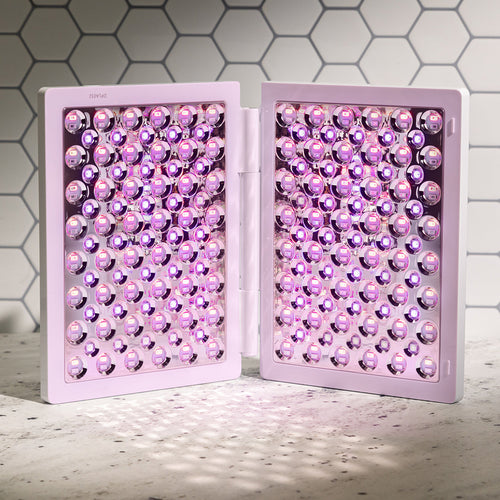
A red light panel is a flat, stationary device that emits light across a relatively large surface area. You position yourself in front of it at a specific distance, typically 6 to 12 inches, and let the light work across the treatment zone. Panels are designed to cover wide areas of the face or body in a single session, which is one of their most meaningful practical advantages.
Because panels house many individual LEDs, they can deliver consistent irradiance (measured in mW/cm²) across the entire treatment surface. This matters because therapeutic dose is not just about total wattage. Irradiance at the skin surface is what determines whether the light reaches the target tissue depth at a meaningful level.
The Lux dpl IIa from reVive Light Therapy™ is a prime example of this format. Engineered for both anti-aging and acne applications, it delivers red and blue light therapy across a panel format designed for full facial coverage, at a level of output that consistently supports visible skin results.
Practical advantages of panels
● Full-face coverage in one session: No repositioning required. The light works across the entire target area simultaneously.
● Consistent output: The distance and angle remain fixed, which means dose consistency session to session.
● Time efficiency: Because coverage is broad, treatment time per area is reduced compared to treating zone by zone.
● Hands-free use: Once positioned, you can stay completely still, which also promotes a relaxed, mindful session.
Where panels have limits
While they excel at full-face or broad-area treatment, panels aren't optimized for ultra-targeted application on a very small zone like the lip line or a specific blemish.
Handheld Red Light Devices: Targeted Precision, Portable Convenience
What handhelds deliver
Handheld devices are compact, battery-powered or rechargeable tools that you hold directly against or close to the skin. They concentrate light output on a smaller surface area, which makes them ideal for targeting specific zones with precision.
This portability comes with genuine value. You can use a handheld at your desk, during travel, or anywhere your routine takes you. There's no setup, no distance calibration, and no required clear space.
The reVive Light Therapy™ Lux Glō and the Lux Clinical are handheld formats designed for this kind of targeted red and blue light delivery. The Lux Spot takes it further, concentrating blue and red light specifically on individual blemishes for on-the-go targeted treatment.
Practical advantages of handhelds
● Portability: Fits in a travel bag or desk drawer with ease.
● Targeted application: Ideal for the lips, jawline, specific blemishes, or any small area requiring focused attention.
● Low commitment to space: No panel stand, no fixed setup area required.
● Ease of use: Pick up, use, put down.
Where handhelds have limits
Because the treatment surface is smaller, treating the full face with a handheld takes longer. You'll need to move the device section by section, which makes maintaining a consistent routine more demanding than a panel. Coverage per session is genuinely narrower.
Red Light Panel vs Handheld: Side-by-Side Comparison
|
Feature |
Red Light Panel |
Handheld Device |
|
Coverage area |
Full face / broad zones |
Small, targeted zones |
|
Session efficiency |
High (treats full area at once) |
Lower (zone-by-zone) |
|
Best for |
Full-face rejuvenation, consistent daily routine |
Spot treatment, travel, targeted concerns |
|
Price range |
Higher |
Lower to mid-range |
What About LED Masks? A Third Format Worth Knowing
LED masks occupy a distinct position between panels and handhelds. They conform to the face, delivering light simultaneously across the full facial surface without requiring you to position yourself in front of a panel. This makes them hands-free and ergonomically convenient, but they're designed exclusively for facial use and typically carry a higher price point.
If your primary focus is facial skin rejuvenation and you value both hands-free use and full-face coverage in a wearable format, a mask can be a compelling option. But if your goals include treating the neck, décolletage, or other areas beyond the face, a panel offers far greater flexibility.
Are Handheld Devices Actually Effective?
Yes, with the right expectations. Handheld red light therapy devices are effective for the use cases they're designed for. The key variables are wavelength accuracy, irradiance at the skin surface, and treatment consistency.
A split-face randomized controlled trial found that red light LED protocols (660 nm) produced meaningful reductions in periocular wrinkle volume after consistent sessions.³ The study confirms what photobiomodulation research has consistently shown: efficacy depends on the quality and wavelength accuracy of light delivery, not on the form factor of the device.
What matters less than format is consistency. Photobiomodulation requires regular, cumulative sessions over weeks to produce visible change. A handheld used daily will outperform a panel used sporadically.
Is a Red Light Panel Worth the Investment?
For anyone building a structured at-home skincare routine with visible anti-aging results as the goal, a panel is a strong long-term investment. The efficiency of treating the full face in a single session, combined with the consistent irradiance output of a quality device, supports the kind of disciplined daily habit that produces real results over 8 to 12 weeks.
A prospective, randomized controlled study involving 136 volunteers found that participants using red light treatment experienced significantly improved skin complexion and measurable increases in intradermal collagen density compared to controls.² This kind of sustained structural change is what a consistent, well-designed panel routine is built to support.
The Lux dpl IIa is reVive Light Therapy™'s full-panel option for those serious about integrating LED therapy into a premium skincare regimen.
How to Choose: Panel or Handheld?
Choose a panel if you:
● Want to treat the full face in a single, efficient session
● Are focused on consistent anti-aging results across the full face
● Value a hands-free, stationary ritual
Choose a handheld if you:
● Are targeting specific zones like a lip line, blemish, or spot concern
● Are newer to LED therapy and want to start with a lower investment
● Prefer a compact, low-setup format
What to Look for in Any Red Light Therapy Device
Regardless of format, these technical markers separate quality devices from the rest:
● Wavelength: Look for devices specifying 630 nm or 660 nm for red light skin applications. Light in this range penetrates to the dermis where fibroblasts produce collagen and elastin, which is where the most meaningful cellular activity takes place.¹
● Irradiance (mW/cm²): This is the actual dose delivered to your skin, not total device wattage. Look for this figure specifically.
● FDA clearance: Always look for devices that are FDA-cleared. This distinction matters for both safety and efficacy validation.
● Treatment area and session time: These should align with your actual skin goals and lifestyle.
● Brand transparency: Established brands with documented R&D history, like reVive Light Therapy™ built on nearly 20 years of expertise by LED Technologies, Inc., provide a meaningful level of accountability that newer entrants to the market often cannot.
Ready to Find Your Perfect Device?
Whether you're drawn to the efficiency of a full-face panel or the precision of a targeted handheld, reVive Light Therapy™ has an FDA-cleared option designed to meet you where you are in your skincare journey. All reVive Light Therapy™ devices are formulated to be safe and effective across all skin tones.
Explore the full Lux Collection
Shop Red Light Therapy Devices
Frequently Asked Questions
Is there really a difference between red light therapy devices?
Yes, and it goes beyond format. The most important differences are wavelength accuracy, irradiance at the skin surface, and treatment area. Two devices both marketed as "red light therapy" can deliver meaningfully different results depending on whether they output the clinically studied wavelengths (630–660 nm) at a sufficient irradiance level. FDA clearance is one of the most reliable indicators that a device meets established safety and output standards.
How many sessions do I need before seeing results?
Most published research on red light therapy for skin rejuvenation uses protocols spanning 8 to 12 weeks of consistent sessions, typically 3 to 5 times per week. Results are cumulative, meaning regularity matters far more than any single session. Building the habit is the most important variable within your control.
Can I use both a panel and a handheld device?
Absolutely. Many people use a panel for full-face sessions and a handheld for more targeted follow-up on specific concerns, such as a persistent blemish or the lip area. These two formats complement each other well. Just make sure you're respecting the recommended session guidelines for each individual device.
Is red light therapy safe for all skin tones?
Yes. LED-based red light therapy works through photobiomodulation, not UV radiation, and does not interact with melanin the way sun exposure does. reVive Light Therapy™ devices are designed to be safe and effective across all skin tones.
Scientific References
¹ Avci P, et al. "Low-level laser (light) therapy (LLLT) in skin: stimulating, healing, restoring." Seminars in Cutaneous Medicine and Surgery, 32(1), 2013. https://pubmed.ncbi.nlm.nih.gov/24049929/
² Wunsch A, Matuschka K. "A controlled trial to determine the efficacy of red and near-infrared light treatment in patient satisfaction, reduction of fine lines, wrinkles, skin roughness, and intradermal collagen density increase." Photomedicine and Laser Surgery, 32(2), 2014. https://pubmed.ncbi.nlm.nih.gov/24286286/
³ Mota LR, et al. "Photobiomodulation Reduces Periocular Wrinkle Volume by 30%: A Randomized Controlled Trial." Photobiomodulation, Photomedicine, and Laser Surgery, 41(2), 2023. https://pubmed.ncbi.nlm.nih.gov/36780572/