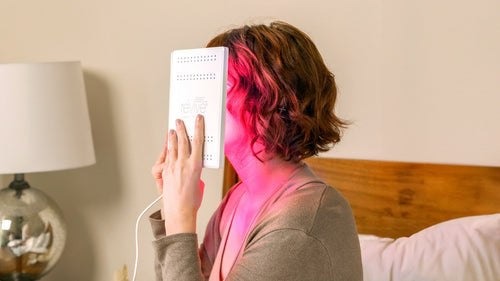
If you've recently added an LED device to your skincare routine, one question tends to follow quickly: when will I actually see results? It's a fair thing to wonder. Collagen is the structural protein that gives skin its firmness, elasticity, and that subtle youthfulness that no filter fully replicates, and rebuilding it takes time and consistency. The good news is that red LED light therapy has one of the most well-documented timelines in non-invasive skincare science. Understanding what's happening at each stage makes it far easier to stay consistent and, ultimately, to see the results you're working toward.
How Red LED Light Triggers Collagen Production at the Cellular Level
To understand the timeline, it helps to understand the mechanism. LED therapy works through a process called photobiomodulation: specific wavelengths of light penetrate the skin and are absorbed by chromophores within the cells, triggering a cascade of biological responses.¹
What Happens Inside the Skin
When red light reaches the dermis, it is absorbed by the mitochondria (the energy centers of your skin cells). This absorption stimulates the production of ATP, or adenosine triphosphate, the molecule that fuels cellular activity.¹ With more available energy, fibroblasts (the cells responsible for synthesizing collagen and elastin) become significantly more active.² Research published in Photomedicine and Laser Surgery by Wunsch and Matuschka confirmed that this process leads to measurable increases in intradermal collagen density, along with visible improvements in skin roughness and fine lines.²
Red Light vs. Near-Infrared: Which Wavelength Does What?
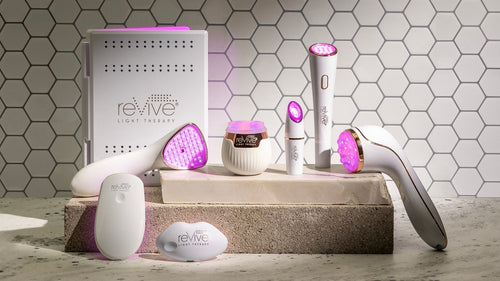
Both red light (typically around 630–660 nm) and near-infrared light (around 830–850 nm) are involved in collagen stimulation, but they work at different depths. Red light targets the upper dermis, making it particularly effective for surface-level concerns like fine lines, uneven skin tone, and texture. Near-infrared light penetrates more deeply into the dermis, supporting structural remodeling over time. Many high-performance at-home devices combine both wavelengths to deliver more comprehensive results. The reVive Light Therapy™ Lux Collection includes devices engineered with both red and infrared wavelengths, designed for consistent, at-home anti-aging treatments.
A Realistic Week-by-Week Timeline for Collagen Results
One of the most common frustrations with LED therapy is expecting quick visible changes, then stopping before the real results have a chance to develop. Here is what the science and clinical experience consistently suggest, phase by phase.
Days 1–7: Cellular Activation Begins
Collagen synthesis starts earlier than most people expect. Research shows that at the cellular level, the biological pathways involved in collagen production can be upregulated within the first days of consistent light exposure.³ The skin is not visibly transformed yet, but the foundational work has already begun.
Weeks 2–4: Early Signals
Some users begin to notice subtle improvements in how their skin feels: a slight increase in firmness, or a more even, rested appearance. These early changes are primarily linked to improved cellular energy and circulation, rather than significant new collagen being laid down. They are real, and they are an encouraging sign that the process is underway.
Weeks 4–8: Collagen Activation Accelerates
This is the phase where consistent use pays off most visibly. With regular sessions (typically three to five times per week), fibroblast activity reaches a more productive rhythm. In the Barolet et al. study, treated skin showed a 31% increase in type-1 procollagen compared to untreated control skin.³ Skin texture often begins to improve noticeably during this window.
Weeks 8–12: Measurable, Visible Results
By the end of the second and third month, collagen remodeling becomes more apparent. This aligns with what dermatology professionals and clinical researchers consistently report: meaningful, objective improvements in skin firmness and the reduction of fine lines tend to emerge in the 8 to 12-week range with steady use. In an in-house study conducted by LED Technologies, Inc., 97.4% of participants reported visible improvements in fine lines, wrinkles, and overall skin tone after 10 weeks of consistent use with a reVive Light Therapy™ device.
Month 3 and Beyond: Maintenance and Continued Improvement
Collagen remodeling is an ongoing process, not a one-time event. Once the initial course of treatment has been completed, most practitioners recommend transitioning to a maintenance rhythm of one to two sessions per week. This keeps fibroblast activity elevated and supports the results already achieved. Skin continues to improve gradually with sustained use.
|
Phase |
Recommended Frequency |
What to Expect |
|
Initial Course (Weeks 1–8) |
3–5x per week |
Collagen activation, early texture improvements |
|
Active Remodeling (Weeks 8–12) |
3–4x per week |
Visible firmness, reduction in fine lines |
|
Maintenance (Month 3+) |
1–2x per week |
Results sustained and progressively refined |
What Color LED Light Actually Stimulates Collagen?
Not all LED wavelengths serve the same purpose. For collagen and anti-aging specifically, red light is the primary wavelength of interest. Research confirms that red LEDs stimulate collagen production in dermal fibroblasts, supporting firmer, more resilient skin over time.⁴
Here is a practical overview of the main wavelengths and their primary skin benefits:
|
LED Color |
Wavelength Range |
Primary Skin Benefit |
|
Red |
630–660 nm |
Collagen stimulation, anti-aging, skin texture |
|
Near-Infrared |
830–850 nm |
Deep tissue remodeling, elastin support |
|
Blue |
415–430 nm |
Acne-causing bacteria reduction |
|
Amber/Yellow |
570–590 nm |
Skin tone, sensitivity, redness |
The American Academy of Dermatology (AAD) has noted red light therapy among the options used by dermatologists to address wrinkles, pigmentation, and skin laxity, which speaks to the modality's growing relevance in professional practice.
For those managing both acne and anti-aging concerns, blue and red light used together offer a complementary approach. The reVive Light Therapy™ Lux Clinical combines both wavelengths in a format designed for precisely that purpose. All reVive Light Therapy™ devices are safe for all skin tones.
Three Factors That Shape Your Personal Timeline
Two people following the same protocol may see slightly different timelines. Several variables influence how quickly results develop.
Device Quality and Energy Output
At-home devices vary in their energy output (measured in irradiance and energy delivered per session). Devices engineered with premium LED arrays, like those in the reVive Light Therapy™ Lux Collection, are designed to deliver therapeutically relevant energy levels within a practical session time, making them a meaningful step up from entry-level consumer devices.
Session Frequency and Consistency
Consistency is, by a wide margin, the most important variable. The collagen remodeling process requires cumulative, repeated stimulation. Sporadic use interrupts that rhythm, while steady, regular sessions compound over time to produce progressively better results.
Your Skin Concern and Starting Point
Timeline also varies by concern. Acne and surface-level inflammation tend to respond faster, often within two to four weeks. Structural changes such as increased collagen density require more sustained effort, with the 6 to 12-week window being the realistic target for meaningful visible results.
Explore the reVive Light Therapy™ Anti-Aging Collection
Frequently Asked Questions
Does red light therapy really rebuild collagen?
Yes, the science behind this is well-established. Red light stimulates fibroblasts (the cells that produce collagen and elastin) through a process called photobiomodulation. Multiple peer-reviewed studies have documented measurable increases in collagen density following consistent LED therapy. Results build gradually, with the most significant changes typically emerging between weeks 8 and 12 of regular use.
What color LED light is best for collagen stimulation?
Red light, in the 630–660 nm wavelength range, is the most studied wavelength for collagen production. Near-infrared light (around 830–850 nm) complements it by penetrating more deeply, supporting structural remodeling in the lower dermis. For anti-aging purposes, a device that combines both wavelengths tends to deliver the most well-rounded results over time.
Does LED light therapy help with sagging skin?
Red light therapy is one of the non-invasive options referenced by dermatologists for improving skin laxity. By supporting collagen and elastin production over time, consistent use can contribute to a firmer, more lifted appearance. Results are gradual and depend on regularity of use, and the underlying mechanism is well-supported by photobiomodulation research.
Can I use LED therapy every day for faster collagen results?
Daily use is generally well-tolerated for most at-home LED devices, since they operate without UV radiation and at non-thermal energy levels. Following each device's recommended protocol and transitioning to a maintenance phase once initial results are achieved remains the most sustainable and effective approach for long-term collagen support.
¹ Avci P, et al. "Low-level laser (light) therapy (LLLT) in skin: stimulating, healing, restoring." Seminars in Cutaneous Medicine and Surgery, 32(1), 2013. https://pubmed.ncbi.nlm.nih.gov/24049929/
² Wunsch A, Matuschka K. "A Controlled Trial to Determine the Efficacy of Red and Near-Infrared Light Treatment in Patient Satisfaction, Reduction of Fine Lines, Wrinkles, Skin Roughness, and Intradermal Collagen Density Increase." Photomedicine and Laser Surgery, 32(2), 2014. https://pubmed.ncbi.nlm.nih.gov/24286286/
³ Barolet D, et al. "Regulation of Skin Collagen Metabolism In Vitro Using a Pulsed 660 nm LED Light Source: Clinical Correlation with a Single-Blinded Study." Journal of Investigative Dermatology, 129(12), 2009. https://pubmed.ncbi.nlm.nih.gov/19587693/
⁴ Lee SY, et al. "Clinical study to evaluate the efficacy and safety of home-used LED and IRED mask for crow's feet: A multi-center, randomized, double-blind, sham-controlled study." Medicine, 2025. https://pmc.ncbi.nlm.nih.gov/articles/PMC11835066/