If you've been using an LED light therapy device for your skin and found yourself wondering whether those red wavelengths could affect your eyes, you're asking exactly the right question. The short answer: when you use a well-designed, properly calibrated at-home device and follow the recommended safety precautions, red light therapy poses no meaningful risk to your eyes. But as with any light-based technology, understanding how it works and respecting a few simple guidelines makes all the difference. Here's what you actually need to know.
How Red Light Therapy Interacts With the Eyes
Red light therapy, also known as photobiomodulation, uses specific wavelengths of visible red light, typically in the 630–660 nm range, to stimulate cellular activity in the skin. The therapy is thought to work by targeting mitochondria, the energy-producing structures within cells, increasing their production of ATP, which enhances cell repair, growth, and function.¹
When an LED device is used on the face, the eyes are in close proximity to the light source, which raises a natural question about exposure. The key distinction to understand here is the difference between red visible light (630–660 nm) and near-infrared light (NIR, 800–850 nm). These two ranges behave differently in biological tissue and carry different implications for ocular safety. Research notes that the eye's lens naturally concentrates incoming light, which is why eye safety deserves particular attention in any light-based therapy context.²
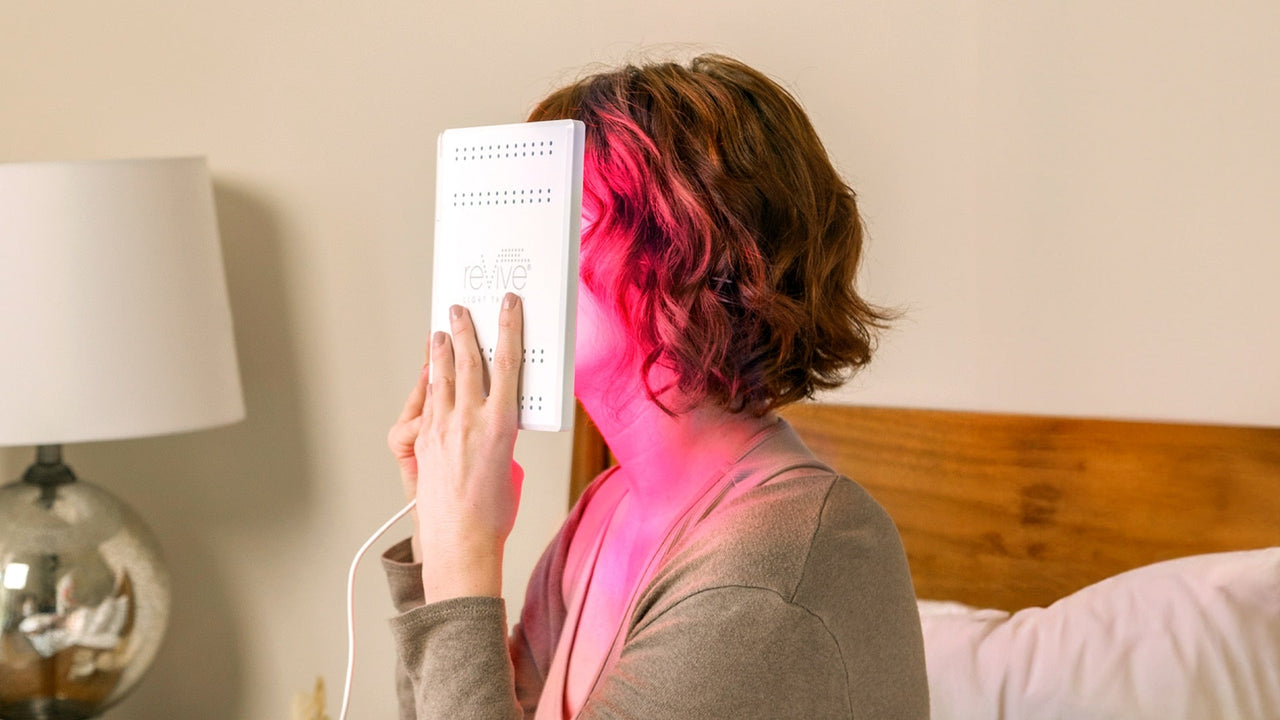
At-home cosmetic LED devices, including the reVive Light Therapy™ lineup, are designed for skin use at low power outputs. They operate at a fundamentally different intensity level than the high-powered panels or laser systems used in clinical settings. This distinction matters enormously when evaluating eye safety.
What the Science Says About Red Light Therapy and Eye Safety
The body of research on photobiomodulation and ocular safety continues to grow, and the picture that emerges for properly used LED devices is reassuring. The clinical safety of photobiomodulation has been well documented, and the few reports on adverse events have been primarily linked to the improper use of laser-based devices, not consumer LED tools.²
Current clinical and preclinical evidence supports the safety of photobiomodulation for skin rejuvenation purposes, with no significant adverse events identified in trials conducted under proper protocols.³ Research has confirmed that LED light at wavelengths between 600–660 nm and 800–860 nm stimulates cells in the skin's dermal and epidermal layers, supporting wrinkle improvement and skin quality over time.⁴ These are the wavelengths that power reVive Light Therapy™ devices, calibrated specifically for skin-level, non-invasive use.
When Eye Exposure Warrants Caution
Responsible use of any technology starts with an honest understanding of its limitations, and red light therapy is no different. The risks associated with LED light therapy and the eyes are almost always linked to misuse: staring directly into a device, using it too close to the face for too long, or skipping recommended eye protection with more powerful systems.
Any light source, when pointed directly into the eyes at close range for extended periods, can cause eye strain or discomfort. That is true of sunlight, bright screens, and LED therapy devices alike. The key variables are intensity, distance, and duration, and at-home cosmetic devices are specifically engineered to operate within safe parameters on all three counts.
Protective eyewear appropriate to the device's wavelength range adds a meaningful layer of reassurance when using any light therapy tool near the face, particularly for panel-style systems with broader coverage areas.² For low-output, handheld skincare devices, simply closing your eyes and following the manufacturer's protocol is the baseline recommendation. The takeaway: the device you use matters. Power output, wavelength calibration, and device design are the variables that determine how cautiously you need to approach eye protection.
Should You Close Your Eyes During Red Light Therapy?
Yes, always. Whether you're using a handheld tool or a panel-style device, keeping your eyes closed during any facial treatment is the simplest and most effective precaution you can take. Closed eyelids act as a natural filter, substantially reducing the amount of light that reaches the sensitive tissues inside the eye, and making the session more comfortable overall.
That said, eyelids alone may not provide complete protection in every situation. For low-intensity at-home devices used according to the manufacturer's guidelines, closed eyes are typically sufficient. For panel-style systems covering a broader area of the face, wearing purpose-designed protective eyewear is the more conservative and recommended approach.
For the reVive Light Therapy™ Lux dpl IIa LED Treatment Panel, which delivers precision red and blue wavelengths across a broader treatment area, using the included eye protection during facial protocols is the recommended approach. Always defer to the instructions provided with your specific device.
Why Is My Vision Slightly Blurry After a Red Light Therapy Session?
If you've noticed a brief moment of visual adjustment immediately after using your LED device, there's no cause for concern. This is the same physiological response your eyes produce after stepping out of bright sunlight or looking away from a lit screen in a darkened room. Your visual system simply needs a moment to recalibrate after exposure to a bright light source, and the adjustment resolves on its own within a few minutes.
A 2024 systematic review published in the Asia-Pacific Journal of Ophthalmology found that the most commonly reported visual side effect of repeated red light therapy was temporary afterimages lasting a few minutes, with no irreversible vision loss identified across the studies reviewed.⁵
If any visual discomfort persists beyond a few minutes or feels unusual, discontinuing use and consulting a healthcare professional is always the right call.
5 Simple Eye Safety Rules for Red Light Therapy
Following a few consistent habits ensures every session is both effective and comfortable:
- Always close your eyes during any facial treatment, regardless of device intensity.
- Wear protective eyewear when provided. Purpose-designed therapy goggles offer wavelength-specific protection that standard sunglasses cannot replicate. Always follow your device's included instructions.
- Respect the recommended distance. At-home devices are designed to be used at a specific distance from the skin. Reducing that distance does not improve results and may increase unnecessary light exposure.
- Stay within the recommended session time. Calibrated doses are the foundation of safe, effective photobiomodulation. More time does not mean better outcomes.
- Consult your eye care provider if you have a pre-existing eye condition before beginning any light therapy regimen near the face.
Explore the reVive Light Therapy™ Collection
Ready to experience the benefits of red light therapy for your skin, with devices engineered for safe, effective at-home use?
Explore the Red Light Therapy Collection
Discover the Full Lux Collection
Frequently Asked Questions
Is it safe to use red light therapy on the face near the eyes?
Yes, when used correctly. Keep your eyes closed during facial treatments, follow the recommended distance and session duration, and use any protective eyewear included with your device. At-home cosmetic LED devices operate at low power outputs specifically designed for safe skin use.
Can red LED light damage your retina?
Retinal damage from LED-based at-home skincare devices is not a documented concern when devices are used as directed. The power levels in cosmetic LED tools are fundamentally lower than clinical or laser-based systems. Avoiding prolonged, direct eye exposure to any bright light source is a sound general practice.
Red light therapy: eyes open or closed?
Always closed during facial treatments. Closed eyelids significantly reduce the light reaching ocular tissue and make sessions more comfortable. For panel-style devices used close to the face, purpose-designed protective goggles provide an additional layer of comfort and reassurance.
Should I see an eye doctor before starting red light therapy?
If you have an existing eye condition, checking with your ophthalmologist before beginning any light therapy routine near the face is a good idea. For healthy adults using low-intensity at-home skincare devices, no special medical clearance is typically required, though consulting your physician is always a reasonable step when introducing any new wellness practice.
References
¹ Avci P, Gupta A, Sadasivam M, et al. "Low-level laser (light) therapy (LLLT) in skin: stimulating, healing, restoring." Seminars in Cutaneous Medicine and Surgery, 32(1):41–52, 2013. https://pubmed.ncbi.nlm.nih.gov/24049929/
² Hamblin MR. "Mechanisms and applications of the anti-inflammatory effects of photobiomodulation." AIMS Biophysics, 4(3):337–361, 2017. https://www.ncbi.nlm.nih.gov/pmc/articles/PMC5523874/
³ Mosca RC, et al. "Photobiomodulation: A Systematic Review of the Oncologic Safety of Low-Level Light Therapy for Aesthetic Skin Rejuvenation." Photobiomodulation, Photomedicine, and Laser Surgery, 2023. https://www.ncbi.nlm.nih.gov/pmc/articles/PMC10309024/
⁴ Kim HK, et al. "Clinical study to evaluate the efficacy and safety of a home-used LED and IRED mask for crow's feet: a multi-center, randomized, double-blind, sham-controlled study." Lasers in Medical Science, 2025. https://www.ncbi.nlm.nih.gov/pmc/articles/PMC11835066/
⁵ Chen Y, Xiong R, Yang S, et al. "Safety of repeated low-level red-light therapy for myopia: A systematic review." Asia-Pacific Journal of Ophthalmology, 13(6):100124, 2024. https://pubmed.ncbi.nlm.nih.gov/39672511/