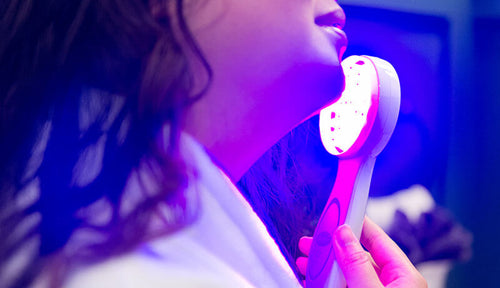
If you've started exploring LED light therapy for acne, you've likely noticed that "blue light device" is a broad category. There are handheld wands, full-face masks, compact spot treatments, and panel systems, all positioned for the same general purpose. So what actually separates them? The answer goes beyond form factor. Understanding how each device type works, what it's designed to do, and how it fits into a consistent skincare routine will help you make a more informed decision and get real, lasting results.
How Blue Light Works Against Acne in the First Place
Before comparing device formats, it helps to understand the science behind blue light therapy. The mechanism is well-documented in photobiomodulation research and relies on a specific interaction between light and the skin.
Acne-causing bacteria naturally produce compounds called porphyrins inside hair follicles. When blue light at around 415 nm reaches the skin, those compounds absorb it in a way that disrupts the bacteria's ability to survive. The result is a measurable reduction in the bacteria responsible for inflammatory breakouts, without any chemicals or physical contact with the skin.¹
Research has confirmed this mechanism through both laboratory observations and controlled studies in people with mild-to-moderate facial acne, demonstrating meaningful improvements in skin condition over consistent treatment periods.²
In an in-house study conducted by LED Technologies, Inc., 100% of participants noted improvements in skin texture and overall condition after consistent use of blue light therapy. You can read the full findings in the acne treatment blue light therapy study.
With that foundation in mind, the key question becomes: how does the format of a device shape how, and how effectively, that light reaches the skin?
The Main Types of Blue Light Acne Devices
Spot Treatment Devices
Spot treatment devices are compact, handheld tools engineered to deliver targeted blue light directly onto individual blemishes. They represent the most focused format available and are well-suited for addressing isolated breakouts as they emerge.
Rather than treating the entire face, a spot device concentrates light energy on a specific area, making it a precise and practical everyday tool. It integrates easily into a morning or evening routine and can be used without disrupting the rest of the complexion. The reVive Light Therapy™ Lux Spot ($39) is built around exactly this use case, combining blue and red light for targeted acne treatment in a compact, accessible format.
Full-Face LED Panels and Masks
Panel-style devices and full-face masks take a broader approach. Rather than addressing one blemish at a time, they treat a large surface area in a single session, making them well-suited for people dealing with widespread or recurring breakouts across the face.
This format also tends to support a more integrated skincare experience. Many panel and mask devices combine multiple wavelengths simultaneously, so a single session can address acne while also supporting overall skin tone and texture. Sessions are typically hands-free, allowing you to relax during treatment without moving the device manually.
The reVive Light Therapy™ Lux dpl IIa ($399) delivers both blue and red light across a generously sized LED panel, making it a comprehensive option for addressing acne alongside anti-aging concerns in a single treatment.
Combination Blue and Red Light Devices
Many of the most sophisticated at-home acne devices now combine blue and red wavelengths in a single tool. This pairing is grounded in peer-reviewed research. In a 107-patient randomized trial published in the British Journal of Dermatology, both blue-only (415 nm) and combined blue and red (415 nm and 660 nm) phototherapy significantly reduced inflammatory acne lesions compared with control groups, with the blue and red combination producing the strongest overall result after 12 weeks.³
The rationale is straightforward: blue light works at the surface level to address acne-causing bacteria, while red light penetrates more deeply and works to reduce inflammation and support skin recovery. Together, the two wavelengths address the full cycle of a breakout, from its bacterial origin to its inflammatory aftermath.
reVive Light Therapy™ has built this dual-wavelength approach into several of its devices. The Lux Glō ($79) and the Lux Clinical ($199) both combine blue and red light therapy for more complete skin treatment. The Lux Soniqué Mini Cleanser ($129) takes this further by integrating blue and red light into a daily cleansing step.
How to Choose the Right Blue Light Device for Your Skin
The best format depends on your skin's specific needs, your lifestyle, and how realistically you'll use the device on a consistent basis.
|
Device Type |
Best For |
Coverage |
Typical Session |
|
Spot treatment |
Isolated, occasional breakouts |
Targeted / single blemish |
3 to 5 min per spot |
|
Full-face panel / mask |
Widespread or recurring acne |
Full face |
10 to 15 min per session |
|
Combination blue and red |
Acne, inflammation, and skin recovery |
Variable by device |
3 to 15 min |
A few factors worth reflecting on:
● Acne pattern: Occasional pimples are well-served by a spot device. Persistent or widespread breakouts benefit from the broader coverage of a panel or mask.
● Treatment goals: If you're managing acne alongside early signs of aging, a combination blue and red device offers meaningful value on both fronts.
● Consistency: The format that fits most naturally into your routine is the one you'll actually use. With LED therapy, consistency is what drives visible results over time.
Regardless of format, one principle applies across all blue light devices: regular, sustained use matters. The Papageorgiou study tracked participants over 12 weeks, and meaningful improvements in inflammatory lesion counts were observed progressively throughout that period.³ Committing to a routine is as important as choosing the right device.
All reVive Light Therapy™ devices are engineered to be safe for all skin tones, designed for at-home use, and built on nearly 20 years of R&D by LED Technologies, Inc.
Explore the reVive Light Therapy™ Acne Collection
Whether you're looking for a precise spot treatment or a comprehensive full-face system, reVive Light Therapy™ offers FDA-cleared solutions to support your skin goals.
Explore the Anti-Acne Collection | Shop Blue Light Therapy Devices
Free shipping on orders over $75 (contiguous US). FSA/HSA eligible.
Frequently Asked Questions
Can I use a blue light device every day?
Usage frequency depends on the specific device and its output level. Most at-home blue light devices are designed for use several times per week. Always follow the recommended protocol for your specific device to support safe, effective results over time.
Is blue light therapy safe for all skin tones?
Yes. Blue light therapy works through a photochemical interaction with naturally occurring compounds in the skin and is considered safe for all skin tones. Unlike some treatments that rely on heat or pigment contrast, LED therapy at these wavelengths does not carry risks related to melanin levels.
What is the difference between blue light and red light for acne?
Blue light, around 415 nm, works primarily by targeting the bacteria that contribute to breakouts. Red light penetrates more deeply and supports skin recovery by helping to calm inflammation. The two wavelengths address different aspects of the breakout cycle, which is why combination devices often deliver more complete results.
How long before I see results from a blue light acne device?
Most people begin noticing changes in skin clarity and breakout frequency within several weeks of consistent use. Research-backed protocols suggest that 8 to 12 weeks of regular sessions are typically associated with meaningful, sustained improvement in inflammatory acne.³
¹ Pei S, Inamadar AC, Adya KA, Tsoukas MM. "Light-based therapies in acne treatment." Indian Dermatology Online Journal, 6(3), 2015. https://pmc.ncbi.nlm.nih.gov/articles/PMC4439741/
² Gold MH, Andriessen A, Biron J, Andriessen H. "Clinical efficacy of self-applied blue light therapy for mild-to-moderate facial acne." Journal of Clinical and Aesthetic Dermatology, 2(3), 2009. https://pmc.ncbi.nlm.nih.gov/articles/PMC2923954/
³ Papageorgiou P, Katsambas A, Chu A. "Phototherapy with blue (415 nm) and red (660 nm) light in the treatment of acne vulgaris." British Journal of Dermatology, 142(5), 2000. https://pubmed.ncbi.nlm.nih.gov/10809858/