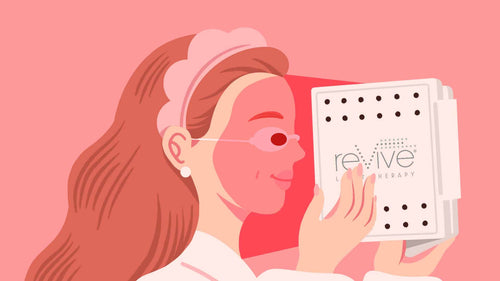
If you've been exploring LED light therapy for your skin, you've likely run into this question. Clinics and medspas offer professional-grade LED sessions. Thoughtfully engineered home devices let you treat your skin on your own schedule, without appointments or commute. Both use the same fundamental science. So where do they actually stand in relation to each other?
The honest answer is nuanced, and that's a good thing. At-home and in-office LED therapy are not the same experience, but they are not in opposition either. They serve different goals, different lifestyles, and different timelines. Understanding the distinction is what allows you to make the right choice for your skin and your life.
How LED Light Therapy Works on Your Skin
LED light therapy is grounded in a well-documented biological process called photobiomodulation. In simple terms, specific wavelengths of light penetrate the skin and interact with cells at an energy-production level, triggering a cascade of natural regenerative responses.
Red light, typically in the 630–660 nm range, stimulates skin cells to increase collagen and elastin production. A controlled trial published in Photomedicine and Laser Surgery found significant increases in collagen density and measurable reductions in fine lines following consistent red light exposure.¹ A randomized clinical trial published in Photobiomodulation, Photomedicine, and Laser Surgery confirmed a reduction in wrinkle volume of over 30% around the eye area after a structured light therapy protocol.² Blue light, peaking around 415 nm, works through a completely different mechanism: it targets compounds naturally produced by acne-causing bacteria, triggering a photochemical reaction that neutralizes them at the source.³
The science is the same regardless of where the device is used. What changes between a clinic and your home is how that science is delivered.
The Real Difference: Power, Precision, and Protocol
In-office LED systems are medical-grade devices. They operate at higher energy outputs, cover more surface area, and deliver precise, calibrated doses of light. When you sit under a professional panel, the energy delivered to your skin is measured, consistent, and optimized for clinical results. Professional protocols are also typically designed around a series of sessions conducted over weeks, which accumulates therapeutic exposure in a structured, controlled way.
At-home devices work within a different power range. Consumer-grade LED devices are engineered for safe, repeated daily use without clinical supervision, which means they operate at lower intensity levels than their in-office counterparts. The result is a more gradual delivery of light energy to the skin. This is not a design flaw — it is a deliberate and appropriate calibration for unsupervised use.
What home devices offer in return is something that clinic visits simply cannot: frequency and consistency. The ability to use your device several times per week, over months, on your own terms, represents a meaningful therapeutic advantage. Regular, sustained exposure has been shown to accumulate meaningful results over time, and for many skin concerns, that consistency matters more than any single high-powered session.⁴
Does At-Home LED Therapy Actually Deliver Results?
Yes, and the evidence supports it. An in-house study conducted by LED Technologies, Inc. found that 97.4% of participants reported visible improvement in fine lines and skin tone after 10 weeks of consistent red light use. A separate in-house study conducted by LED Technologies, Inc. showed that 100% of participants experienced improvement in skin condition with blue light therapy for acne. These are compelling figures, and they reflect what consistent, regular home use can achieve.
What users consistently report across skincare communities for adults 30 and over: visible improvements in skin texture, a more even tone, and a reduction in breakout frequency. These results build progressively. For anti-aging applications, most users begin to notice meaningful change between weeks 6 and 12 of regular use. For acne, improvements in active breakouts can appear sooner, often within the first few weeks.
The key variable across both professional and home LED therapy is consistency. A session in a dermatologist's office attended once a month will likely produce less cumulative impact than a home device used three to five times per week over the same period.
At-Home vs. In-Office: A Practical Comparison
|
|
In-Office LED |
At-Home LED |
|
Power output |
Medical-grade, high intensity |
Consumer-safe, lower intensity |
|
Session frequency |
Typically 1x/week or less |
Daily or near-daily use |
|
Results timeline |
Faster per session |
Gradual, builds over weeks |
|
Cost |
$75–$200+ per session |
One-time device investment |
|
Convenience |
Appointment required |
On your own schedule |
|
Ideal for |
Accelerated results, complex concerns |
Prevention, maintenance, ongoing skin health |
The takeaway from this comparison is not that one option beats the other. It's that they address different needs. If you're preparing for an event, working through a significant skin concern under a dermatologist's guidance, or want the fastest possible results, a professional series makes sense. If your goal is long-term skin health, aging prevention, and the ability to maintain results without recurring costs, a well-engineered home device is a genuinely smart investment.
Choosing the Right reVive Light Therapy™ Device for Your Goals
reVive Light Therapy™ devices are engineered by LED Technologies, Inc. with nearly 20 years of R&D behind them. The lineup is designed to address specific skin goals, not to be one-size-fits-all.
For comprehensive anti-aging and acne treatment, the Lux dpl IIa combines blue and red light in a full-panel format, delivering broad coverage for consistent, whole-face treatments. If you're looking for clinical-level performance at home, the Lux Clinical offers an advanced combination of red and blue light targeting both aging and acne concerns. For targeted spot treatment of breakouts, the compact Lux Spot delivers precision-focused blue and red light directly at the source. And for those focused specifically on the lip area, the Lux Lip Care delivers dedicated red light therapy to support lip fullness and texture.
Every reVive Light Therapy™ device is FDA-cleared, UV-free, and designed to be safe for all skin tones.
What to Expect: A Realistic Results Timeline
Patience is part of the protocol with at-home LED therapy. Here's a general framework based on consistent use:
● Weeks 1–3: Skin may begin to feel more comfortable; early signs of reduced inflammation in acne-prone skin
● Weeks 4–6: Improvements in skin tone and texture become more visible; breakouts may become less frequent
● Weeks 8–12: Fine lines appear softer; skin tone more uniform; collagen-related changes become noticeable
● Beyond 12 weeks: Continued improvements with regular maintenance use
Individual results will vary based on skin type, device used, treatment frequency, and other factors in your skincare routine.
Safety and Precautions Worth Knowing
LED light therapy has a well-established safety profile. It does not use UV light, it does not generate significant heat, and it is considered a low-risk option for cosmetic skin use. A few straightforward precautions apply regardless of whether you're treating at home or in a clinic:
● Always protect your eyes during treatments by keeping them closed or wearing the protective eyewear provided with your device
● Those using photosensitizing medications should consult a healthcare provider before starting
● If you have a diagnosed skin condition or are under dermatological care, it's worth discussing LED therapy with your provider before adding it to your routine
Some users experience mild, temporary redness right after a session, which typically resolves on its own quickly. Starting with shorter sessions and building up gradually is always a sensible approach.
Explore the reVive Light Therapy™ collections and find the device that fits your skin goals:
Explore the Anti-Aging Collection | Discover Blue Light Therapy for Acne
Frequently Asked Questions
How many sessions does it take to see results with at-home LED therapy?
Most users begin to notice visible improvements in skin tone and texture between weeks 4 and 6 of consistent use. For anti-aging goals, significant collagen-related changes typically become apparent around weeks 8 to 12. Frequency of use plays a significant role in how quickly results develop.
Can I use at-home LED therapy alongside my regular skincare routine?
In most cases, yes. LED light therapy is designed to complement, not replace, your existing skincare routine. For best results, cleanse your skin before each session and apply any serums or moisturizers afterward. Certain active ingredients such as strong retinoids may require a short interval between application and your LED session; your skincare provider can advise on timing.
Is LED light therapy safe for darker skin tones?
Yes. LED light therapy does not use UV wavelengths and works through a light-energy mechanism rather than anything that interacts with skin pigmentation. It is considered safe and appropriate for all skin tones when used as directed.
What is the difference between red light and blue light therapy for skin?
Red light (around 630–660 nm) primarily targets anti-aging concerns by supporting collagen and elastin production in the deeper layers of the skin. Blue light (around 415 nm) works at the surface level to neutralize acne-causing bacteria. Many reVive Light Therapy™ devices combine both wavelengths to address both concerns simultaneously.
References
¹ Wunsch A, Matuschka K. "A controlled trial to determine the efficacy of red and near-infrared light treatment in patient satisfaction, reduction of fine lines, wrinkles, skin roughness, and intradermal collagen density increase." Photomedicine and Laser Surgery, 32(2), 2014. https://pubmed.ncbi.nlm.nih.gov/24286286/
² Mota LR, Duarte IDS, Galache TR, Pretti KMDS, Neto OC, Motta LJ, Horliana ACRT, Silva DFTD, Pavani C. "Photobiomodulation Reduces Periocular Wrinkle Volume by 30%: A Randomized Controlled Trial." Photobiomodulation, Photomedicine, and Laser Surgery, 41(2), 2023. https://pubmed.ncbi.nlm.nih.gov/36780572/
³ Elman M, Lebzelter J. "Light therapy in the treatment of acne vulgaris." Dermatologic Surgery, 30(2), 2004. https://pubmed.ncbi.nlm.nih.gov/14756640/
⁴ Avci P, et al. "Low-level laser (light) therapy (LLLT) in skin: stimulating, healing, restoring." Seminars in Cutaneous Medicine and Surgery, 32(1), 2013. https://pubmed.ncbi.nlm.nih.gov/24049929/